School Timings: 9.00 AM - 2.00 PM

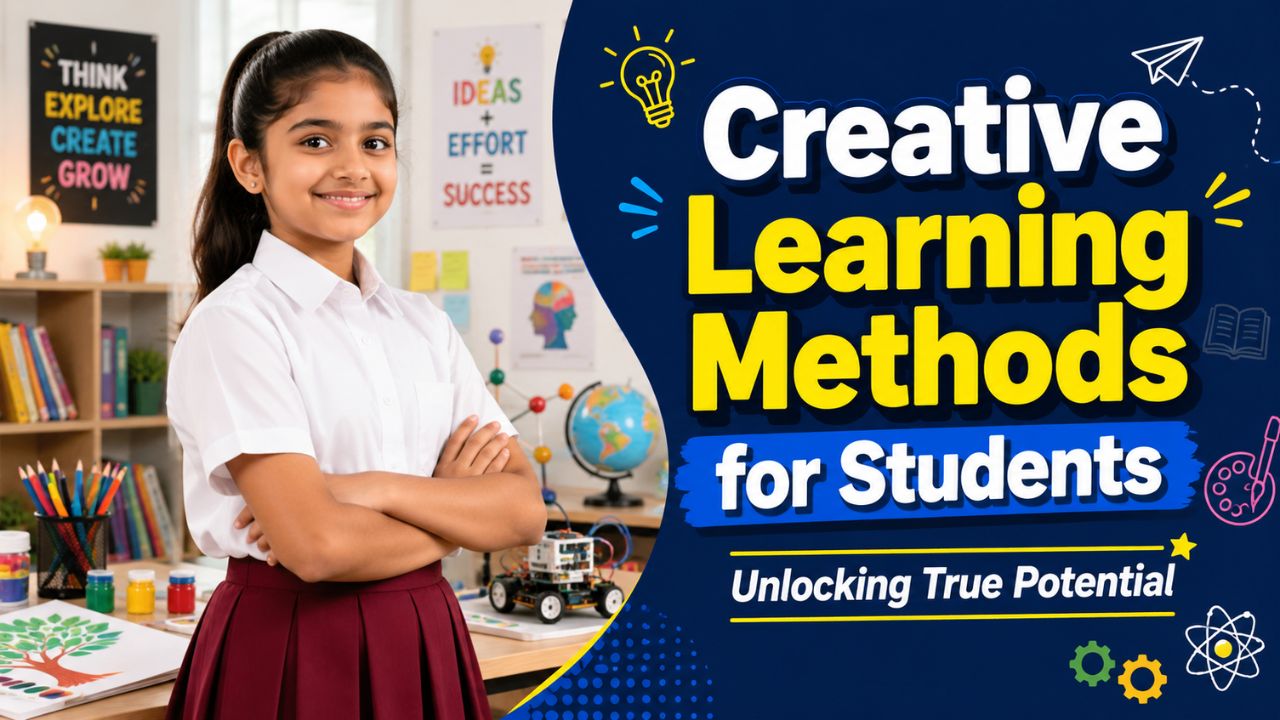
Education is evolving rapidly. Traditional classroom methods—rote memorization, passive lectures, and standardized testing—can no longer fully prepare students for the demands of the 21st century. Today’s students need creative learning methods that promote curiosity, critical thinking, collaboration, communication, and problem-solving.
Creative learning empowers students to actively engage with knowledge, explore different solutions, and develop skills that extend beyond textbooks. Instead of simply receiving information, students participate in the learning process, ask questions, test ideas, and connect academic concepts with real-life situations.
At Hera Public School, these approaches are integrated into daily learning, helping students grow academically while also developing essential life skills. The purpose of creative education is not limited to producing better test scores. It also helps children become confident thinkers, responsible team members, thoughtful decision-makers, and independent learners.
The most effective creative learning methods for students give children opportunities to imagine, investigate, create, experiment, reflect, and improve. These approaches make classrooms more interactive and help students understand why they are learning a concept, how it can be applied, and where it may be useful in the future.
 Creative learning methods for students through interactive classroom activities at Hera Public School
Creative learning is a student-centred educational approach that focuses on engagement, exploration, imagination, and practical application. Unlike traditional methods that often emphasize memorization, creative learning encourages students to understand concepts deeply and apply them meaningfully.
Creative learning encourages students to:
Think critically
Solve real-world problems
Collaborate effectively
Communicate their ideas
Reflect and innovate
Learn from mistakes
Connect different subjects
Build confidence in their abilities
One of the strongest advantages of creative learning is that it recognizes that every child learns differently. Some students understand concepts by reading, while others learn better through diagrams, discussions, practical activities, stories, experiments, or movement. Creative teaching allows educators to use multiple approaches so that more students can participate successfully.
Key benefits include:
Enhanced Engagement: Active participation keeps students motivated and attentive.
Stronger Retention: Hands-on learning helps students remember information for longer.
Critical Thinking Skills: Students learn to analyze, compare, evaluate, and create solutions.
Collaboration and Social Skills: Team activities build empathy, communication, and cooperation.
Confidence and Self-Efficacy: Students take pride in their ideas and accomplishments.
Improved Communication: Presentations and discussions help students express themselves clearly.
Greater Curiosity: Open-ended learning encourages students to ask meaningful questions.
Future Readiness: Creativity, adaptability, and collaboration prepare students for higher education and professional life.
Creative learning does not remove academic discipline. Instead, it strengthens academic understanding by making lessons more purposeful, relatable, and memorable. Educational resources published by UNESCO also emphasize the importance of inclusive, meaningful, and future-focused learning.
In a traditional classroom, students may spend most of their time listening, copying notes, and preparing to reproduce information in examinations. In a creative classroom, students still learn the required syllabus, but the learning process becomes more active.
For example, instead of only reading about environmental conservation, students may survey waste generation in their school, create awareness posters, calculate the amount of recyclable material, and present practical solutions. One activity can connect science, mathematics, language, art, and social responsibility.
Similarly, instead of memorizing the features of a historical period, students may create a timeline, perform a short role-play, design a newspaper from that era, or compare historical decisions with present-day situations. These approaches help students understand context rather than merely remember isolated facts.
Creative classrooms also make space for student voice. Learners can explain what they understood, ask for clarification, suggest new ideas, and participate in activities and presentations. This sense of ownership improves motivation and responsibility.
Students are also encouraged to see mistakes differently. Instead of viewing an incorrect answer as a failure, they learn to examine what went wrong, revise their approach, and try again. This builds resilience and helps children develop a positive attitude towards challenges.
Experiential learning emphasizes learning by doing. Students actively participate in an activity and then reflect on what they observed, understood, or discovered. This makes learning tangible and memorable.
Examples include:
Conducting science experiments
Visiting historical or ecological sites
Participating in community projects
Creating models and prototypes
Gardening and environmental activities
Conducting interviews and surveys
A lesson on plant growth becomes more meaningful when students grow seeds, observe changes, record measurements, and compare results. Through this activity, they can learn science, mathematics, writing, patience, and responsibility.
Experiential learning also helps students understand the practical importance of academic subjects. Mathematical concepts become more relevant when children use them to measure objects, prepare a budget, interpret data, or calculate distances.
Practical Tip: Teachers can design activities that simulate real-world challenges, such as building a model of a sustainable city, planning a water-saving campaign, or analyzing a local environmental issue.
Experiential learning is one of the most valuable creative learning methods for students because it turns abstract ideas into practical experiences.
 Students using project-based and collaborative creative learning methods in the classroom
Project-Based Learning, commonly known as PBL, allows students to work on meaningful projects over a period of time. A project may require research, planning, collaboration, creativity, decision-making, and presentation.
Benefits include:
Encouraging problem-solving and critical thinking
Fostering teamwork and communication
Connecting academic concepts to practical applications
Building responsibility and time-management skills
Developing research and presentation abilities
Encouraging students to revise and improve their work
For example, students creating a “Renewable Energy Project” can combine science, mathematics, environmental studies, art, and communication. They may calculate energy use, compare renewable sources, design a model, and present recommendations.
At Hera Public School, project-based learning gives students opportunities to explore ideas while applying knowledge creatively. Projects also allow teachers to observe how students think, communicate, and solve problems, rather than assessing learning only through written tests.
A good project should include a clear question, student research, practical creation, feedback, and reflection. The final outcome may be a model, report, presentation, campaign, performance, or digital product.
Project-based learning also teaches students how to manage long-term responsibilities. They learn to divide a large task into smaller steps, assign roles, meet deadlines, solve disagreements, and improve their work after receiving feedback.
Inquiry-based learning begins with curiosity. Instead of giving students every answer immediately, teachers encourage them to ask questions, investigate possibilities, collect evidence, and reach conclusions.
The main steps are:
Ask: Pose open-ended and thought-provoking questions.
Investigate: Conduct research, experiments, observations, or interviews.
Analyze: Examine information and identify patterns.
Reflect: Consider what was learned and what remains unclear.
Share: Present findings creatively.
For example, instead of telling students why some objects float and others sink, a teacher may provide different materials and ask students to predict, test, compare, and explain their findings.
Inquiry-based learning develops intellectual curiosity, independent thinking, and lifelong learning habits. Students become more comfortable asking “why,” “how,” and “what would happen if.”
This method also teaches students to evaluate information. They learn that every source may not be equally reliable and that conclusions should be supported by evidence. These habits become increasingly important as students access more information through books, websites, videos, and digital platforms.
Learning is often strengthened when students work together. Collaborative learning emphasizes teamwork, peer-to-peer teaching, shared responsibility, and collective problem-solving.
Useful techniques include:
Group projects
Paired discussions
Peer review sessions
Cooperative problem-solving
Debate teams
Think-pair-share activities
Group presentations
Shared research assignments
Benefits include:
Improved communication
Stronger social skills
Development of leadership
Greater accountability
Increased empathy
Respect for different perspectives
Better conflict-resolution skills
Collaborative learning prepares students for real-world professional and social environments. In most careers, people must communicate, divide responsibilities, listen to others, manage disagreements, and work towards a common objective.
Teachers can make collaboration more effective by assigning clear roles, setting expectations, monitoring participation, and including individual reflection. This ensures that every student contributes meaningfully.
Collaboration also enables peer learning. Sometimes, a student may understand an explanation from a classmate more easily because it is expressed in familiar language. Explaining concepts to others also strengthens the understanding of the student who is teaching.
Many students understand information better when it is presented visually. Visual and artistic learning uses images, colours, diagrams, movement, design, and creative expression to strengthen understanding.
Examples include:
Mind maps and infographics
Timelines and storyboards
Scientific diagrams
Posters and models
Role-play
Drawing and painting
Creative writing
Music and rhythm
A student learning about the water cycle may remember the concept more effectively by drawing and labelling the cycle, creating a model, or presenting it as a story.
Visual learning helps simplify complex ideas. Artistic expression also allows students to communicate understanding in ways that may not always be possible through written answers alone.
For example, students studying literature can design character maps, create storyboards, or perform scenes from a text. Students studying geography can create maps, charts, models, and visual comparisons of different regions.
These activities do not replace reading and writing. Instead, they reinforce academic concepts through an additional form of expression.
Gamification integrates game-like elements into the learning process. These may include points, levels, challenges, badges, teams, progress charts, rewards, and friendly competition.
Advantages include:
Increasing motivation
Encouraging persistence
Making practice enjoyable
Providing immediate feedback
Supporting goal-setting
Encouraging active participation
For example, students may earn points for solving mathematics problems, completing reading challenges, helping teammates, or improving their previous performance.
However, gamification should not focus only on winning. It should reward effort, improvement, participation, teamwork, and problem-solving. The objective is to make learning engaging without creating unhealthy pressure.
UNICEF also highlights the importance of learning through play in supporting children’s imagination, independence, and problem-solving abilities.
Teachers can use gamification in simple ways without expensive technology. A classroom quiz, team challenge, learning board, progress tracker, or puzzle-based activity can motivate students and make revision more interesting.
 Technology-enhanced creative learning for students through practical classroom activities
Modern classrooms can use digital tools to make lessons interactive and flexible. Technology-enhanced learning may include tablets, interactive whiteboards, educational apps, virtual simulations, digital presentations, videos, and quizzes.
Benefits include:
Access to a wide range of learning resources
Safe experimentation through simulations
Personalized learning paths
Immediate feedback
Better visualization of complex concepts
Opportunities for digital creativity
Interactive revision and assessment
For example, students may explore the solar system through a virtual simulation, create digital stories, design presentations, or participate in interactive quizzes.
Technology should support learning objectives rather than distract from them. Teachers must choose age-appropriate tools and balance screen-based learning with physical activities, discussion, reading, and practical work.
Students should also learn responsible digital behaviour. This includes protecting personal information, checking the reliability of online sources, communicating respectfully, and understanding the difference between using technology creatively and consuming content passively.
Storytelling makes information meaningful and memorable. Stories help students connect emotionally with ideas and understand different perspectives.
Teachers can use storytelling in:
History
Science
Languages
Social studies
Moral education
Environmental studies
A science teacher can explain the journey of a drop of water to teach the water cycle, while a history teacher can describe an event from the viewpoint of different people.
Students can also create their own stories to demonstrate understanding. Storytelling improves listening, imagination, vocabulary, sequencing, and communication skills.
Storytelling is especially effective when introducing a new concept. A relevant story can capture attention, establish context, and help students relate unfamiliar ideas to familiar experiences.
Older students can also use storytelling in presentations, debates, research projects, and public speaking. Learning how to communicate facts through a clear and engaging narrative is a valuable academic and professional skill.
Problem-based learning presents students with a practical problem that may have several possible solutions. Students must understand the situation, gather information, evaluate alternatives, and suggest an appropriate response.
Examples include:
How can the school reduce water waste?
How can traffic near the school be managed safely?
How can plastic use in the community be reduced?
How can a healthy meal plan be created within a budget?
How can a classroom become more energy-efficient?
This method builds logical thinking, research skills, teamwork, and decision-making. Students learn that complex problems often require patience, creativity, evidence, and cooperation.
Problem-based learning also helps students become comfortable with uncertainty. In real life, problems do not always have one correct answer. Students must consider different viewpoints, understand limitations, and choose the most practical solution.
Teachers can increase the value of these activities by asking students to explain why they selected a particular solution and what possible disadvantages it may have.
Design thinking encourages students to solve problems by understanding people’s needs, generating ideas, creating prototypes, and improving solutions through feedback.
The main stages include:
Understanding the user or situation
Defining the problem
Generating different ideas
Creating a basic prototype
Testing the solution
Collecting feedback
Improving the design
For example, students may design a more comfortable school bag, create a classroom organizer, improve a school noticeboard, or develop a campaign for road safety.
Design thinking teaches children that the first idea is not always the best or final answer. It encourages them to test their assumptions, accept feedback, and revise their work.
This process develops patience, empathy, innovation, and practical problem-solving. It also shows students that creativity is not only related to art. Creativity can be used to improve products, systems, services, communication, and everyday experiences.
Cross-curricular learning connects two or more subjects through a common theme, question, or activity. This helps students understand that knowledge is not divided into completely separate areas.
For example, a project on local culture may include:
History of the region
Geography and maps
Language through interviews
Mathematics through data collection
Art through traditional designs
Technology through digital presentations
A project on healthy living may combine biology, physical education, mathematics, food science, and communication.
Cross-curricular learning helps students transfer knowledge from one subject to another. It also makes academic content more relevant because students understand how different fields work together in real situations.
Creative learning is not only about activities and projects. Reflection is equally important. Students need time to think about what they learned, what they found difficult, what strategies worked, and how they can improve.
Useful techniques include:
Learning journals
Reflection questions
Guided breathing exercises
Post-project discussions
Self-assessment
Peer feedback
Goal-setting
End-of-lesson reflection
Benefits include:
Reduced stress
Better focus
Stronger understanding
Improved emotional awareness
Greater responsibility for learning
Better ability to learn from mistakes
Reflection helps students recognize their progress and understand that learning is an ongoing process.
After completing a project, teachers can ask students questions such as:
What did you learn?
What was the most difficult part?
How did your team solve disagreements?
What would you do differently next time?
Which skill did you improve?
These questions help students understand both the academic content and the process through which they learned it.
Teachers play a central role in creating a classroom environment where creativity can grow. Their role is not reduced when students become more active. In fact, creative learning requires careful planning, observation, guidance, and assessment.
Teachers can support creativity by:
Asking open-ended questions
Encouraging students to explain their reasoning
Allowing more than one possible solution
Connecting lessons with real-life examples
Creating safe opportunities for experimentation
Treating mistakes as learning opportunities
Providing constructive feedback
Using different teaching methods
Encouraging quiet as well as confident students
Celebrating improvement and effort
A creative teacher does not need expensive technology or complex materials for every lesson. Simple questions, local examples, group discussions, recycled materials, stories, and classroom challenges can also make learning highly effective.
Teachers also need to create psychological safety in the classroom. Students should feel comfortable sharing an unusual idea or asking a basic question without being embarrassed. When students feel respected, they are more willing to participate and take intellectual risks.
At the same time, creative learning should remain structured. Clear instructions, learning objectives, timelines, group roles, and assessment criteria help students use their creativity productively.
Parents can strengthen creative learning methods for students by creating an encouraging environment at home. They do not need to become formal teachers. Their role is to support curiosity, conversation, exploration, and responsibility.
Parents can:
Encourage children to ask questions
Listen patiently to their ideas
Provide art supplies, books, puzzles, and science materials
Allow time for hobbies and creative play
Involve children in cooking, budgeting, gardening, and planning
Discuss real-world events in age-appropriate ways
Encourage reading beyond textbooks
Support group activities and sports
Limit passive screen time
Encourage children to create rather than only consume content
Ask children what they learned and how they learned it
Praise effort, improvement, and persistence
Give children age-appropriate responsibilities
Everyday activities can become valuable learning experiences. Cooking develops measurement and sequencing skills. Shopping can teach budgeting and comparison. Travel can support geography and observation. Household planning can build responsibility and decision-making.
Parents should also allow children to make manageable mistakes. When children are given opportunities to try, fail, reflect, and try again, they develop resilience and confidence.
Instead of immediately giving an answer, parents can ask questions such as:
What do you think?
How could we find out?
Is there another way to solve this?
What happened when you tried?
What could you change next time?
These questions encourage children to think independently.
Parents should avoid comparing one child’s creativity with another’s. Some children express creativity through art, while others show it through problem-solving, building, storytelling, leadership, humor, technology, or practical work.
Effective implementation of creative learning methods for students requires planning at the school level. Individual activities are useful, but long-term impact is stronger when creative learning becomes part of the school’s overall culture.
Important areas include:
Schools should integrate project-based, inquiry-based, experiential, and collaborative activities into the curriculum. Creative learning should support academic goals rather than function as an occasional extra activity.
Activities should be connected with clear learning outcomes. Teachers should know what knowledge, skill, or value students are expected to develop through each task.
Teachers need practical training in activity design, questioning techniques, classroom management, assessment, technology use, and differentiated instruction.
Training should also provide teachers with examples that can be adapted for different subjects and age groups.
Classrooms with movable furniture, project corners, reading spaces, display boards, and activity zones can encourage participation. Even in limited spaces, teachers can reorganize seating based on the activity.
Students may sit in pairs for discussion, small groups for projects, or a circle for reflection. The arrangement should support the objective of the lesson.
Assessment should evaluate understanding, application, creativity, collaboration, communication, and problem-solving. Written examinations remain important, but they should be supported by projects, presentations, portfolios, observations, and practical tasks.
Clear assessment rubrics help students understand what is expected. A project may be assessed on research quality, originality, teamwork, communication, accuracy, and reflection.
Creative methods should support students with different abilities, interests, and learning preferences. Teachers can provide multiple ways to participate and demonstrate understanding.
For example, one student may create a written report, another may design a visual presentation, and another may build a model while meeting the same learning objective.
Schools can involve local professionals, parents, community organizations, and educational institutions in projects, talks, visits, and practical learning activities.
Community involvement helps students understand how classroom knowledge is applied outside school. It can also introduce them to different careers, responsibilities, and social issues.
Creative learning can face challenges, especially when teachers must complete a large syllabus, manage large classes, and prepare students for examinations.
Common challenges include:
Limited classroom time
Lack of materials
Large class sizes
Unequal student participation
Pressure to complete the syllabus
Overuse of technology
Difficulty assessing creative work
Fear of classroom disorder
Practical solutions include:
Using short creative activities within regular lessons
Choosing low-cost or reusable materials
Assigning clear roles in group work
Combining creative tasks with syllabus objectives
Using simple assessment rubrics
Balancing technology with offline activities
Setting clear classroom rules
Starting with one method and expanding gradually
Creative learning does not require every lesson to become a major project. A five-minute discussion, a visual explanation, a practical demonstration, or an open-ended question can make a meaningful difference.
Teachers can begin by selecting one lesson each week that can be taught using a new method. Over time, they can identify the most effective techniques and integrate them more regularly.
Hera Public School aims to build a modern, student-centred learning environment where students can develop academically, socially, emotionally, and creatively.
The school’s learning approach supports:
Project-based and inquiry-based learning
Collaboration and peer-to-peer interaction
Responsible use of technology
Arts, STEM, and innovation
Communication and leadership skills
Holistic development
Emotional intelligence
Practical understanding
Confidence and independent thinking
Students benefit when academic learning is combined with creativity, discipline, values, teamwork, and real-world awareness. The objective is to prepare children not only for examinations but also for future education, careers, relationships, and responsibilities.
By using creative learning methods for students, Hera Public School helps learners become active participants in their education. They are encouraged to understand concepts deeply, express ideas clearly, work with others, and approach challenges with confidence.
Students also need a supportive environment in which their individual interests and strengths are recognized. A child who performs well in science may be encouraged to experiment, while a child interested in language may participate in storytelling, debate, or creative writing.
Similarly, students interested in technology, sports, art, leadership, or social service can be given appropriate opportunities to explore and develop their potential.
The future will require students to do more than remember information. Information is widely available, but students must know how to evaluate it, apply it, communicate it, and use it responsibly.
Creative learning helps students develop:
Adaptability
Critical thinking
Digital literacy
Collaboration
Communication
Creativity
Leadership
Resilience
Ethical decision-making
Self-directed learning
These abilities are useful in almost every field. Whether a student becomes a doctor, engineer, teacher, entrepreneur, artist, researcher, manager, or public servant, the ability to learn, adapt, communicate, and solve problems will remain valuable.
Creative learning also teaches students that improvement is possible. They learn to accept feedback, revise their work, and continue trying. This growth-oriented attitude is essential for long-term success.
Future workplaces will require people to collaborate with individuals from different backgrounds, use new technologies, respond to changing situations, and solve problems that may not yet exist. Creative learning develops the flexibility and confidence required to face such situations.
Creative learning is an essential part of modern education. It transforms students from passive listeners into active thinkers, explorers, creators, and problem-solvers. Through experiential learning, projects, inquiry, collaboration, visual methods, storytelling, gamification, technology, reflection, and problem-based learning, students develop academic knowledge as well as essential life skills.
The strongest creative learning methods for students make lessons relevant, engaging, and practical. They help children understand concepts deeply, communicate confidently, work responsibly with others, and respond positively to challenges.
Parents, teachers, and schools all have an important role in supporting this approach. When students are given the freedom to ask questions, test ideas, learn from mistakes, and improve their work, they become more confident and independent.
At Hera Public School, a focus on creative and holistic education helps students pursue academic success while also preparing them for future opportunities and responsibilities. By combining strong academic foundations with creativity, values, collaboration, and practical learning, schools can unlock the true potential of every child.
The focus keyword is distributed across the introduction, main headings, body sections, school section, and conclusion without excessive repetition.
